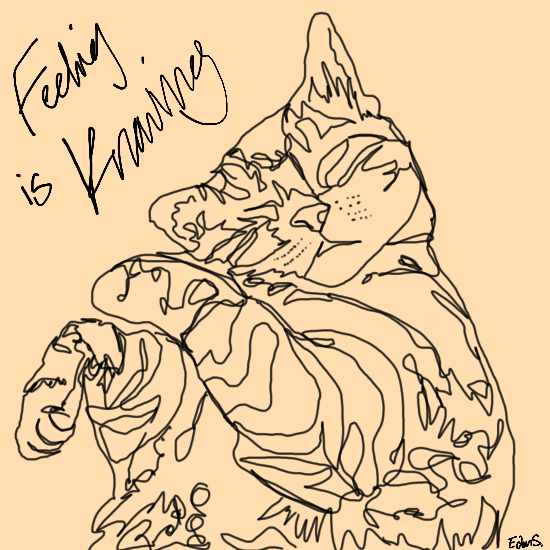
The Art of Autistic Joy is a project that creates space for the exploration of the concept of autistic joy, sensory self-care, and what we can learn about resistance, community, and power strucutres from the autistic standpoint.
This project is informed by personal experience in the form of academic and informal works by autistic and neurodivergent people, the work of critical autism studies (CAS) scholars, critical gender, sexuality, and race theories scholars, and critical affect theory scholars.
While this project is grounded in high academic theory, it’s goal is to reach lay audiences by translating the important work of theorists into digestible and accessible information for the average person.
There are many facets to this project including blog posts, a collective art project, full-length research projects, linguistic analyses, and a resource list.
What is Joy?
Joy is…
Joy is the embodied feeling of liberation from oppression.
Joy is a “nonbifurcated experience” which is defined as“‘the self-enjoyment of being one among many, and of being one arising out of the composition of the many’ (Whitehead, 1985, 145). Thus is not a self-satisfying moment in time that essentially begins in a human head, brain, mind, body, or AI algorithm. Human experience can be ‘an act of self-origination,’ but it is constrained to a ‘perspective of a focal region, located within the body…but not necessarily persisting in any fixed coordination with a definite part of the brain’…In short, experience cannot be decoupled from its entanglement with the ‘whole of nature.’ Experience is continuous to material assemblages (technological or otherwise) and their encounter with the entire temporal thickness of events.” (Sampson, 2023).
Joy is in this way, a collective experience. Whether we are experiencing joy while sharing physical space with other beings, or psychological space, we are not able to experience joy alone because to feel free from oppression is to be free from a system that affects other beings and there is no such thing as individual liberation.
Our sense of joy is relative to our experience of oppression. For example, autistic joy is distinguished from black joy because autistic joy is the product of being liberated from a neurotypical power system that allows autisticness to exist in its fullest, whereas black joy comes out of liberation from racist power systems that allows blackness to exist in its fullest. This expression of fullness–of realignment with the self, values, and/or environment–will look different for each group and be brought about by liberation from different things.
I am defining autistic joy specifically as liberation from harmful neurotypical systems that seek to suppress our natural ways of being, feeling, and relating.
How is this Project Understanding Autism?
Here, Autism is Defined as…
As an autistic person in conversation with other Critical Autism Studies scholars and autists, I theorize that the phenomenon that we call “autism” is actually a complex and variable set of differences in one’s nervous system that influence how we experience and process sensory information and shape our experiences of the world as fundamentally different from those not labeled as “autistic.” Sensory information includes any information that comes from the traditionally understood five senses but also information that comes from our social, emotional, and affective senses.
I acknowledge that these nervous system differences impact behavior and social communication for many people, but I disagree with how the current diagnostic criteria upholds these “persistent deficits” as defining characteristics of being autistic.
I would argue that these are traits of autisticness but they are not traits that all autistic people share to the same degree, however it is true that our current diagnostic criteria is only capable of recognizing individuals whose traits meet a certain threshold. With this in mind it is critical that we respect the validity of self-diagnosis for those who the diagnostic system does not currently recognize.
For me, “autism” also denotes a particular way of processing and making meaning, usually through thinking or cognizing, but in other modes of thinking also. Theorist Erin Manning (2024) points out that neurodivergence is more fairly understood as a way of thinking and making meaning of the world that is different from the dominant (neurotypical) systems for thinking and meaning making.
Therefore, I also understand “autism” as a term to describe a unique and particular way of thinking and experiencing the world, and that to be autistic/an autist is to engage with this alternative way of thinking. For autistic people this alternative mode of processing is not something that we choose to do, but is inextricable from our ways of being and knowing. It is something that comes naturally to use because of our nervous system differences. However, non-autistic people can also engage with neurodivergent or autistic forms of thinking and meaning making by thinking in sensory modes (in/with their senses, in images) and outside of limiting neurotypical modes of logic.
 The Art of Autistic Joy