There are a lot of people who write about autism. Some do it really well, but many are written through perspectives that belittle the autistic experience or limit how audiences understand autistic identity by writing in ways that pander to neurotypical audiences.
In my research I have come across many written works that hold their integrity in a world that would rather have them have frame autistic experience through a neurotypical lens. I understand holding integrity to mean: using language/grammar structures that are not simple or traditional but which more accurately capture one’s complex experience; sharing with audiences the hardest, and most joyful, experiences that come with being autistic (meltdowns, misunderstandings, prejudice, sensory joy, experiences of stimming, the process of making space for ourselves) without glossing them over; and breaking free of the typical autistic narrative that centers diagnosis or the overcoming of disability as a primary struggle in our lives.
The following books are works that have both informed my research and my personal understanding and experiences of what it means to be autistic. Being autistic being both autistic in a social/historical sense, and autistic in what it feels like to have a different nervous system. These books are doing radical work to reshape what we think we know about autistic people and experience and will hopefully cause readers to take up curiousity about us and our ways of being.
“Asperger’s Children: The Origins of Autism in Nazi Vienna.” by Edith Sheffer.
One of the books that started it all for me. This well-researched history of the origins of the autism diagnosis is an essential for anyone looking to understand why the concept of autism is what it is today and what role Nazi ideology played in it’s founding and still plays in our present-day diagnosis. One of the most salient points that Sheffer makes within the work is how the Nazis used diagnoses to divide people into discrete and controllable categories and justify violence against them through the logics of pathological conditions (ie. making up a diagnosis (defining difference) and then perscribing a “treatment” that was really a way to violently control a certain minority group.) This work calls into question the validity of autism as a soley medical concept and prompts the reader to interrogate their own understandings of autism and diagnosis as unshakeable concepts.
“The Secret Life of a Black Aspie: A Memoir” by Anand Prahlad
Prahlad’s work is notable for the way that he uses poetic non-sequential language to convey his unique experience as a Black, gender-queer, autist growing up in the 60’s and 70’s American south. Reading this piece as an autistic person myself, I felt like Prahlad was able to capture many unique aspects of autistic experience, especially as they relate to sensory experience, through his use of poetics that I had never seen done by anyone else. This work feels honest, unfiltered, and it keeps it’s integrity because it doesn’t care to simplify autistic experience into shorter, digestible descriptions for neurotypical readers. This is an excellent resource for autists who are seeking ways to tell their own stories in linguistic modes that feel authentic to them, as well as for anyone seeking to learn more about the Black and queer experiences that intersect with being autistic.
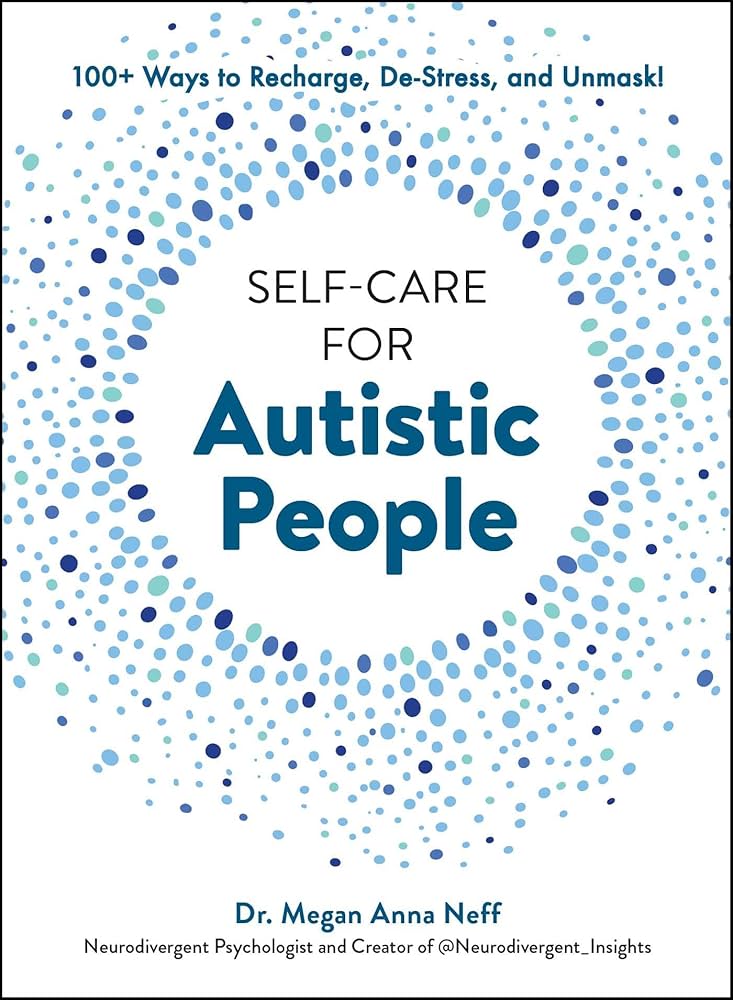
“Self-Care for Autistic People: 100+ Ways to Recharge, De-Stress, and Unmask!” by Dr. Megan Anna Neff
In this seminal text, Dr.Neff walks readers through the need for self-care advice that is tailored to us as individuals, the different realms of self-care, and offers varied, specific, practices that can get people started in caring for themselves more attentivley. The ways that our bodies need care are not singluar-they are unique to one’s own body and our self-care practices must be tailored to us. As a person who has had many therapists recommend generic self-care practices such as breathing tecniques, goal setting, or exersize, that did not work and often left me feeling frustrated when there wasn’t anything else offered, this book is empowering for the way that it encourages people to learn about themselves and assume the authority to become creative in finding solutions to their support needs. Through doing this, Dr.Neff also expands the definition of self-care to sensory self-care, which acknowledges that things like our feelings, our energy, our relationships, and our careers all exist for us in the form of sensory infromation (whether we are sensing through emotions, through our eyes, or through the feedback our body is giving us) and therefore require self-care practices to help us set healthy boundaries, expectations, and find effective methods for re-regulating. This book has the potential to be a great tool for anyone (not only autists) who wants to get curious about their own bodyminds and sensory needs that they may be missing.
Something Missing?
Are there any books or media that you want to see added to this page? Send me a recommendation and I will consider adding it as a resource here!
Botha, Monique, Bridget Dibb, and David M. Frost. 2020. “‘Autism Is Me’: An Investigation of How Autistic Individuals Make Sense of Autism and Stigma.” Disability & Society 37 (3): 427–53. https://doi.org/10.1080/09687599.2020.1822782.
Cvetkovich, Ann. 2023. “Minor Feelings and the Affective Life of Race.” In The Affect Theory Reader, edited by Carolyn Pedwell and Gregory J. Seigworth. Vol. 2. Duke University Press.
Dale, Laura Kate. 2023a. Stories of Autistic Joy. Jessica Kingsley Publishers.
Dale, Laura Kate. 2023b. “The Joy of Diagnosis.” In Stories of Autistic Joy, 210–13. Jessica Kingsley Publishers.
Figueroa, Robert Melchior. 2017. “Autism and Environmental Identity: Environmental Justice and the Chains of Empathy.” In Disability Studies and the Environmental Humanities : Toward an Eco-Crip Theory, edited by Sarah Jaquette Ray, Jay Sibara, and Stacy Alaimo, 573–93. Lincoln, Ne: University Of Nebraska Press.
Gibbons, Sarah . 2017. “Neurological Diversity and Environmental (In)Justice: The Ecological Other in Popular and Journalist Representations of Autism.” In Disability Studies and the Environmental Humanities : Toward an Eco-Crip Theory, edited by
Sarah Jaquette Ray, Jay Sibara, and Stacy Alaimo, 530–51. Lincoln, Ne: University Of Nebraska Press.
Jackson-Perry, David. 2020. “The Autistic Art of Failure? Unknowing Imperfect Systems of Sexuality and Gender.” Scandinavian Journal of Disability Research 22 (1): 221–29. https://doi.org/10.16993/sjdr.634.
Jaquette Ray, Sarah , Jay Sibara, and Stacy Alaimo. 2017. Disability Studies and the Environmental Humanities : Toward an Eco-Crip Theory. Lincoln, Ne: University Of Nebraska Press.
Kapp, Steven K., ed. 2020. Autistic Community and the Neurodiversity Movement: Stories from the Frontline. Singapore: Palgrave Macmillian Imprint and Springer Nature Singapore Pte Ltd. https://link.springer.com/book/10.1007/978-981-13-8437-0.
Kim, Jina B., and Sami Schalk. 2021. “Reclaiming the Radical Politics of Self-Care: A Crip-of-Color Critique.” South Atlantic Quarterly 120 (2): 325–42. https://doi.org/10.1215/00382876-8916074.
Lorde, Audre. 1984. “The Transformation of Silence into Language and Action*.” In Sister Outsider: Essays and Speeches, 41–44. S.L.: Penguin Books.
Lorde, Audre. 2019. “Uses of the Erotic.” In Pleasure Activism : The Politics of Feeling Good, 27–35. Chico, CA: AK Press.
Magnet-Dale, Jane . 2023. “Without Shame.” In Stories of Autistic Joy, 52–63. Jessica Kingsley Publishers.
Manning, Erin. 2024. In Conversation With Erin Manning: A Refusal of Neurotypicality Through Attunements to Learning Otherwise Interview by Vivienne Grace Bozalek. Qualitative Inquiry. https://journals.sagepub.com/doi/10.1177/10778004241254397.
Mitchell, David T., and Sharon L. Snyder. 2023. “Precarity and Cross-Species Identification: Autism, the Critique of Normaitve Cognition, and Nonspeciesism.” In The Affect Theory Reader, edited by Carolyn Pedwell and Gregory J. Seigworth, 2:553–72. Duke University Press.
Neff, Megan Anna. 2024. Self-Care for Autistic People. Simon and Schuster.
Piepzna-Samarasinha, Leah Lakshmi . 2024. “Republics of Desire.” In Disability Intimacy, 144–59. New York, N.Y.: Vintage.
Prahlad, Anand. 2017. The Secret Life of a Black Aspie : A Memoir. Fairbanks, Ak: University Of Alaska Press.
Right Side Broadcasting Network. 2025. “FULL SPEECH: RFK Jr. Holds Press Conference to Provide Updates on Autism Research – 4/16/25.” YouTube. Right Side Broadcasting Network. April 16, 2025. https://www.youtube.com/watch?v=G-N9li4LdmY.
Rose-Bloid, Teagan. 2023. “Rediscovering Myself.” In Stories of Autistic Joy, 108–19. Jessica Kingsley Publishers.
Sampson, Tony D. 2023. “Nonconcious Affect: Cognitive, Embodied, or Nonbifurcated Experience?” In The Affect Theory Reader, edited by Carolyn Pedwell and Gregory J. Seigworth, 2:295–313. Duke University Press.
Sheffer, Edith. 2018. Asperger’s Children: The Origins of Autism in Nazi Vienna. W. W. Norton & Company.
Taitt, Matrim. 2023. “I like to Echo.” In Stories of Autistic Joy, 25–33. Jessica Kingsley Publishers.





 The Art of Autistic Joy